
In recent years, Trento has faced a growing crisis in neighbourhood commerce, characterised by high turnover rates and a rising number of vacant ground-floor spaces in urban areas. This trend mirrors broader challenges across European cities, where shifts in consumer behaviour, urban planning policies, and economic pressures reshape traditional commercial spaces’ function and sustainability.
The research will focus on key areas within Trento’s historical centre—Via San Pietro, Via Suffragio, Via San Martino, and Via Cavour—employing a mixed-method approach that integrates quantitative data analysis with qualitative techniques to uncover diverse perspectives and contributing factors.
By shedding light on the dynamics driving this crisis, the study seeks to equip local policymakers with evidence-based recommendations for targeted strategies to revitalise Trento’s urban fabric and restore vitality to its commercial landscapes.
The project aims to investigate the multifaceted causes of the growing crisis in neighbourhood commerce in Trento, with a specific focus on the increasing prevalence of vacant ground-floor spaces in urban areas.
The crisis in neighbourhood commerce is a complex phenomenon influenced by multiple interconnected factors, including:
Economic Pressures:
- The broader economic downturn and its effect on consumer spending habits.
- The challenges faced by small businesses in competing with multinational retailers and online platforms.
- High operational costs and the burden of taxes and rent on local retailers.
Urban Planning and Policy Issues:
- The impact of traffic and parking policies on access to local businesses.
- The role of public space maintenance and investment in fostering a vibrant retail environment.
- The rise and spread of supermarket centres located outside the historic city centre, such as those along Via Brennero.
Shifting Consumer Preferences:
- Changing lifestyles and the resulting decline in time spent in local shops.
- The growing demand for convenience, digital engagement, and experiential spaces over traditional retail experiences.
Technological Disruption:
- The impact of digital payment systems and e-commerce on small retail businesses.
- The difficulty many small businesses face in adopting digital marketing strategies and integrating e-commerce.
By examining key factors such as shifts in consumer preferences, the growth of e-commerce, and the economic challenges faced by small retailers in the aftermath of COVID-19, this study aims to go beyond simplistic explanations—such as changes in urban accessibility driven by traffic management policies—to provide a more nuanced understanding of the issues.
Drawing on successful urban regeneration examples in Vienna and Carinthia, as discussed in the recent meeting with architect Silvia Forlati, the project will also explore innovative and collaborative strategies to repurpose these “empty spaces.”
To achieve this, the project is organised into four complementary work packages. The class will be divided into four teams, each tasked with a specific aspect of the research. These teams will work collaboratively to develop theoretical frameworks and prepare research tools for data collection. Their activities will include gathering and organizing secondary data (e.g., press articles, statistical data), drafting a preliminary questionnaire and in-depth interview guidelines, conducting pilot interviews, and designing strategies for organizing and involving participants in focus groups. This phased approach will ensure robust preparation for collecting and analysing empirical material.
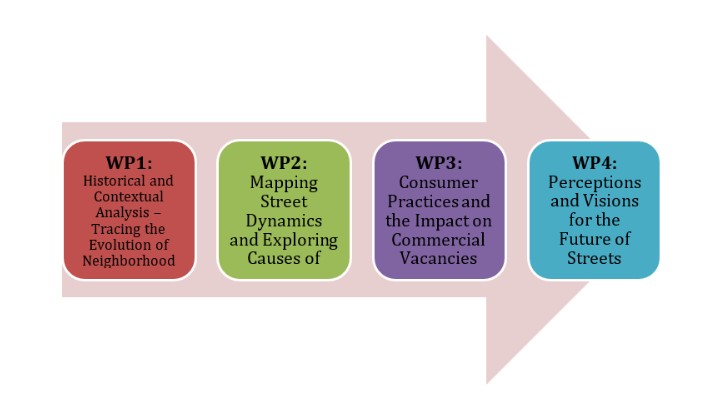
WP1: Historical and Contextual Analysis – Tracing the Evolution of Neighborhood Commerce
Objective:
This WP explores the selected streets’ historical, social, and commercial development, with a particular focus on the dynamics of neighbourhood commerce and the factors influencing its evolution.
Tasks:
- Document Analysis:
Identify and map key trends in business activities, including the rise and decline of specific types of businesses, while analysing the impact of socio-political events on local trade through archival documents and historical records.
- Textual Analysis:
Collect and analyse local newspaper articles, urban reports, and municipal documents to explore key issues affecting the streets, such as urban safety, changes in traffic patterns, and retail transformations driven by factors like increased tourism or the influx of students and other new residents.
- In-depth interviews with Key Informants:
Conduct interviews with individuals possessing historical insights into the selected streets, such as long-term residents, local historians, and business owners.
Deliverables:
A comprehensive mapping of the historical and commercial evolution of the four selected streets, integrating data, testimonies, and narratives from key informants.
WP2: Mapping Street Dynamics and Exploring Causes of Vacancy
Objective:
To examine the physical and social characteristics of the selected streets, including their spatial arrangements, perceptions of safety, and urban challenges that shape local commerce and contribute to the presence of vacant shops.
Tasks:
- Ethnographic Street Walks:
Conduct ethnographic walks to observe and document street characteristics, focusing on physical infrastructure, shop arrangements, pedestrian flow, etc. Identify areas of vulnerability, such as poorly maintained public spaces, security issues, or spatial configurations that may deter foot traffic or commercial activity.
- Georeferenced Mapping:
Create a georeferenced map detailing the types and locations of shops, highlighting vacant premises to visualise patterns of commercial activity and closure.
- Stakeholder Interviews:
Construct the Interview guide for shopkeepers and business owners to gather personal narratives and insights into the factors contributing to commercial vacancies.
Deliverables:
A detailed georeferenced map highlighting commercial features, including vacant shops, thriving commercial zones, and areas with safety concerns, testimonies, and narratives from shopkeepers.
WP3: Consumer Practices and the Impact on Commercial Vacancies
Objective:
To examine how consumer practices shape the commercial landscape, with a focus on shifts in urban commerce dynamics and their connection to vacant retail spaces.
Tasks:
- Online Survey Development:
Design a structured online questionnaire to be distributed through the municipality’s social media channels to gather data on consumption practices, shopping habits, and residents’ awareness of local businesses. The questionnaire will explore factors such as convenience, price sensitivity, and engagement with neighbourhood shops versus online platforms and will include questions on parking availability, accessibility, perceptions of safety, and familiarity with specific streets and areas of the city centre. Control for structural factors such as gender, age, and economic status will ensure comprehensive analysis.
- Supermarket and Online Commerce Audit:
Conduct an audit in some supermarkets and other retail spaces in different areas of Trento, evaluating the prices and availability of essential goods, and compare these findings with data from online retail platforms to assess the competitive pressures brick-and-mortar stores face in the digital commerce era.
- Consumer Interviews:
Construct and taste an Interview for consumers to gather personal narratives and insights into their shopping habits, preferences, and perceptions of local commerce, focusing on factors influencing their choice between local shops and online platforms and the role of accessibility, safety, and pricing in their decision-making.
Deliverables:
A finalised questionnaire on local consumption patterns, narratives from consumer interviews highlighting factors influencing shopping habits and perceptions of local versus online commerce, and a comparative report on pricing and product availability across physical retail spaces and online platforms, assessing the competitive pressures on local stores.
WP4: Perceptions and Visions for the Future of Streets
Objective:
This WP aims to capture the diverse visions and expectations of stakeholders living and working in the four streets, exploring their needs and desires for revitalizing local retail spaces and shaping the future of neighborhood commerce.
Tasks:
- Focus Groups (Co-Imagination):
Develop a strategy for focus group sessions with shop owners, residents, consumers, and other relevant stakeholders to identify their perceived needs, aspirations, and expectations for the future of the selected streets. Think about how to get them involved (we thought about collecting pictures from residents) and how to facilitate discussions.
- Literature review on solutions to revitalise neighbourhood commerce
Conduct a literature review to identify existing urban solutions to revitalise neighborhood commerce. This will include exploring best practices, urban policy interventions, and innovative initiatives worldwide that could inform local efforts to strengthen community-driven retail revitalisation.
Deliverables:
A draft of focus group guidelines tailored to different stakeholder categories, a strategy for conducting these activities effectively and a set of actionable recommendations for urban solutions to revitalise neighbourhood commerce, derived from the literature, including urban policy interventions and initiatives to foster active participation from all stakeholders.
The final essay must be structured as a scientific article, beginning with clearly identifying the research problem and a well-defined research question. The essay should be between 6,000 and 8,000 words per group (a maximum of three authors per paper is allowed) and must include the following sections:
- Title
- Abstract
- Keywords (5)
- Introduction
- Literature Review
- Research Design
- Pilot Study and Discussion of Preliminary Data
- Conclusions
- Bibliography
- A statement outlining each author’s contribution
The introduction should outline the problem’s significance and provide the study context. Following this, the final paper should present the topic, incorporating a comprehensive literature review that references course materials and articles suggested in the L&CP detailed syllabus.
The research design section must expand upon the points developed for each work package (WP), outlining the chosen methodology, the research tools and techniques used, and the rationale behind their selection. Any questionnaires, interview guides, or focus group materials should be included in the appendix.
I expect the final paper to offer an initial reflection on the research problem and the potential insights gained from the research setup. This reflection should be based on an analysis of preliminary results or insights derived from testing the research instruments (such as interview narratives or other data types).
The essay should demonstrate a critical engagement with both the topic and thefirst data collected, discussing the implications of the findings for the research question and the overall objectives of the study.
The final paper must be printed and submitted during a regular exam session (after online registration).

 Academic Research Blog